
Skip to content

Financing Solutions

Balance Sheet Optimisation and Utilization Risk Sharing

Transform equipment financing cost from CAPEX to OPEX and unlock off-balance sheet treatment under IFRS16. This reduces hurdles to investment and enhances KPIs like free cash flow and Total Cost of Ownership (TCO) in case of under-utilisation.

Stapler in Grün
Industry 4.0 meets Finance

Why Pay-per-Use Financing?

Recent years have shown market conditions to be increasingly volatile and less predictable. Add in supply chain issues and it becomes a real challenge for equipment operators to accurately forecast customer demand and plan production in the long run. Old and less efficient equipment worsens the problem with unexpected plant downtime and high energy use.

Effective balance sheet management is also impacted by the chosen financing solution. For example, under IFRS16, equipment and the corresponding liability must be booked on balance sheet when financing through traditional leasing. By contrast, Pay-per-Use financing generally qualifies as an operating expense, thereby supporting companies in having a leaner balance sheet.

Pay-per-Use financing increases financial resilience of businesses during production downtimes, low demand, or unexpected events and helps replace old equipment with new one whilst keeping CAPEX low. By assuming utilisation risk, Linxfour helps equipment operators focus on core competencies.

Frequently asked questions about financing solutions

The maximum contract term is 7 years (84 months). A minimum term of 4 years is generally recommended. Shorter terms are possible. How sensible this is depends on the machine, the application and residual values.

At the end of the contract term, the equipment can be purchased at a previously agreed residual value. Depending on the contractual arrangement, the right or obligation to purchase lies either with the equipment manufacturer or the machine operator.

In the event of early contract termination, the equipment operator will be invoiced the present value of outstanding lease payments for the remaining term. The equipment will be realised by Linxfour, either by transfer to the operator or manufacturer, or by sale on the secondary market. The proceeds from the sale will be credited to the machine operator and offset against outstanding receivables.

Pay-per-Use financing is available only for connected machines. That is those with sensors to measure actions, and the hardware to transfer this data, typically an edge device.

It is crucial that usage or production can be recorded using an independent and clearly measurable billing unit. This includes, for example, operating hours, number of units produced, tonnes, wash cycles, square metres or cubic metres. Historical usage data, an offtake contract or plausible production plans are required to conclude such a contract.

The leasing rate consists of a fixed base fee and a variable, usage-dependent portion. The base fee is charged regardless of actual usage. The variable rate depends on the actual usage of the machine. Usage is measured using billing units, for example: operating hours, laundry, pallets, tonnes of material, kWh, etc.

The ratio between the fixed and variable portions is determined at the beginning of the contract and remains the same for the entire term. It is common for 25%, 50% or 75% of the leasing rate to be usage-dependent. Thereby one-off investment costs (CAPEX) are converted into ongoing, usage-dependent operating costs (OPEX).

The usage of financed equipment is measured by a billing unit. As this is an essential component of the leasing instalment, usage data must be transmitted at least daily. Connecting the machine to the internet is a prerequisite for Pay-per-Use financing. 

Only predefined usage data necessary for billing and risk management is transferred. Process-critical or production-sensitive data is explicitly not transferred. Only the machine operator and Linxfour have access to evaluations. Data transfer is encrypted using TLS v1.3 and SHA-256 standards with RSA signatures. Third parties do not have access to raw data.

Pay-per-Use makes particular sense for usage with seasonal patterns, or which fluctuates month-on-month, but is fairly stable over a 12-month period. Pay-per-Use does not make sense for infrequently used equipment, such as for testing, or R&D, where usage patterns are not stable, infrequent or unpredictable. Equipment needs to be used more than 60% of the agreed planned utilisation viewed over rolling six-month periods, else Linxfour has the right to terminate the contract early.

This is determined jointly between the OEM, the equipment operator and Linxfour. It typically involves a conversation between the OEM, who understands how their equipment is used, the operator who may be fulfilling a particular offtake contract, or has specific circumstances and Linxfour, with our expertise across industries, equipment types and operators.

In the unlikely event that equipment is used less than 60% of planned utilisation over a six-month periods, Linxfour has the right to terminate the contract early. Linxfour is a financing partner for normal business operations, not an insurance provider for extreme events. Furthermore, abuse of the Pay-per-Use model is thereby prevented.

The usage-based portion of the lease payment does not need to be capitalised under IFRS 16. Capitalisation is only required for variable payments that depend on an index or interest rate. This is how the International Accounting Standards Board (IASB) has defined the standard. Since the amount of future payments cannot be determined in advance in usage-based models, capitalisation is not applicable.
This presentation does not constitute tax or accounting advice from Linxfour, but explains the definition of IFRS 16.

No. Sale and leaseback transactions must be capitalised in accordance with IFRS 16. Even with variable Pay-per-Use rates, the expected future payments are forecast and included in the valuation of the right-of-use asset. The reason is that a gain on disposal may not be realised in full as long as there is an economic commitment due to the retained right of use. The off-balance sheet logic applies to new business, but not to sale and leaseback structures.
This explanation of a general principle should not be construed as tax or accounting advice from Linxfour. Please consult your trusted advisor. 

Yes, in the case of sale and leaseback, it is also crucial that assets are unencumbered. This means that they must be free of third-party rights and owned by the operator or seller. Corresponding purchase agreements and invoices are required for this. In addition, the equipment or production lines must be fully functional.

Linxfour works with established international valuation companies to assess existing machinery. These companies have the necessary expertise to evaluate a wide variety of machinery and equipment in accordance with recognised international standards, such as RICS.

How does the Pay-per-Use process work?

After agreeing technical specifications and selling price, Linxfour sends an offer within 72 hours to the equipment operator. If the equipment operator agrees and passes credit checks, Linxfour and the equipment operator sign the Pay-per-Use contract. Linxfour invoices the equipment operator based on monthly usage, including all maintenance, insurance, and financing costs. At the end of the leasing contract, the operator can buy the equipment and become the legal owner.
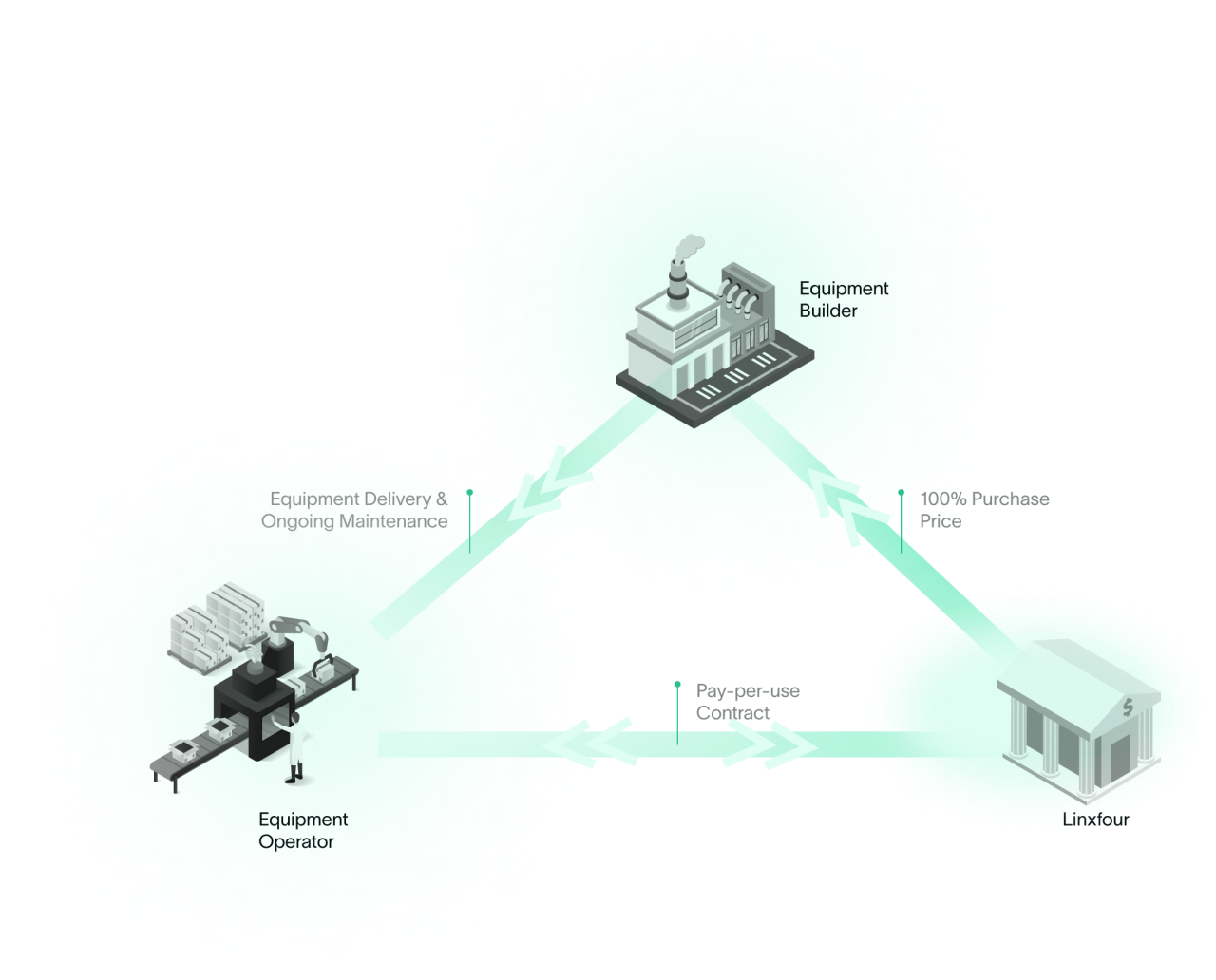
Pay per use Prozess

Optimize your equipment financing

Learn how Linxfour can boost your business today.

The form was successfully submitted!