Productive a year earlier
Pay-per-Use: 36% Less Capex
Beumer Group and RHI Magnesita used Pay-per-Use to finance a critical production line, saving 36% in capex and putting the line into operation a year earlier.
RHI Magnesita used Pay-per-Use to finance the modernisation of its material flow and bagging line at an Austrian production site.
Investments in new production and packaging lines are capital-intensive, and today they face a difficult environment: strict capex limits, long payback periods and demand that is hard to predict. If you size a line for maximum utilisation, you tie up capital that, as a fixed cost, weighs on operating profit whenever the line is underused. If you plan too small, you risk bottlenecks – possibly at points that determine the performance of the entire site.
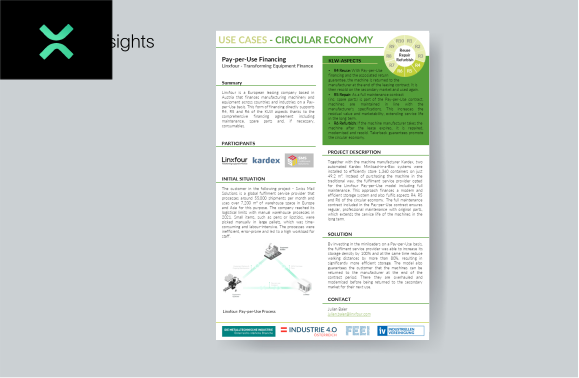
This is exactly where Pay-per-Use comes in. Instead of financing a machine the traditional way through a loan or lease with fixed instalments, the operator pays based on usage – per unit produced, per machine hour or, as in the following project, per loaded pallet. Financing costs therefore follow the revenue the machine generates – a lever for risk sharing, balance-sheet structure and investment speed all at once.
Pay-per-Use: Instead of financing a machine the traditional way through a loan or lease with fixed instalments, the operator pays based on usage.
The project: €1.5 million, five machines, the critical production line
RHI Magnesita, a global manufacturer of refractory products, modernised the material flow and bagging line at one of its production sites in Austria. Beumer Group supplied the machinery; the financing volume was around €1.5 million, spread across five modular machines.
This is no ancillary line: every year, around 110,000 tonnes of refractory product are filled here into 20 kg paper sacks and 250 to 2,000 kg big bags, palletised and wrapped in stretch-hood film for storage and transport. It is the bottleneck through which 100% of the site’s output passes – a truly mission-critical installation. If it becomes the limiting factor, value creation across the entire site is affected.
Shouldering an investment like this the traditional way, in a year with a strict capex limit, would have meant one thing: waiting. Instead, RHI Magnesita opted for Pay-per-Pallet – the pallet-based version of Pay-per-Use. The result:
1. A 36% reduction in capex through Pay-per-Pallet at a low flexibility level – which allowed the project to be realised a year earlier and to fit within the global investment budget. This figure is a project-specific estimate that RHI Magnesita’s accounting team calculated in detail.
2. Conversion of 25% of the fixed financing costs into variable costs that are aligned with revenue from material sales.
3. Off-balance-sheet treatment of the variable part of the financing under the applicable accounting standards.
This turns a one-off, million-euro investment into a cost item that flexes with production: when the line runs at full speed, it pays for itself; when it runs more slowly, costs fall accordingly.
Why the model works for both sides
Usage-based financing does not only take pressure off the operator; it also benefits the machine manufacturer. For RHI Magnesita as the lessee, the key lies in risk transfer: the operator passes a significant share of the utilisation risk – up to 75% – to Linxfour, without penalty payments or automatic contract extensions in the event of underutilisation. If demand falls short of expectations, the investment case does not take the full hit. On top of this come off-balance-sheet treatment under IFRS 16, the shift from capex to opex and – especially when utilisation is low – an optimised total cost of ownership. Capacity that sits idle for a while does not become a costly burden, because it simply incurs no costs.
For Beumer Group as the machine manufacturer, the model pays off in a different way, but no less significantly. Clear benefits for the customer lower the hurdle to closing a deal and increase machine sales. The manufacturer receives the machine price and sales commission immediately and avoids credit risk. And the mandatory maintenance contract creates predictable after-sales revenue over the entire term.
This symmetry – both sides win – is why Pay-per-Use is evolving from a niche model into a strategic tool in machinery and plant engineering. For RHI Magnesita, the project is explicitly a pilot; the lessons learned can, however, be applied to follow-up projects. Sustainability also plays a part: energy-efficient plant technology and optimised logistics are intended to reduce CO₂ emissions.
Pay-per-Use shifts the question from “Can we afford this machine?” to “How much does this machine produce for us?” That is a different way of thinking about investment.
Pay-per-Use: Run the numbers first, then request a quote
However convincing the logic sounds, in practice engaging with Pay-per-Use often stumbles over one simple hurdle: what do the numbers actually look like? Anyone seriously considering usage-based financing wants to understand the figures before engaging with a specific offer. Until now, this easy, low-commitment first step for getting to know the model was missing from the market.
Linxfour is the first provider in the Pay-per-Use field to make these figures available transparently, even before a specific enquiry. Anyone can get a feel for the numbers with the Pay-per-Use Financing Calculator, without first having to go through a sales process. If you can run the numbers first, you make better-informed decisions.
From investment block to flexible cost
The Beumer Group and RHI Magnesita project illustrates what usage-based financing can achieve in a real production environment: realising a critical investment a year earlier, significantly easing the capex budget, sharing the utilisation risk and linking costs to actual output – while the machine manufacturer sells faster and builds long-term service relationships.
Pay-per-Use shifts the question from “Can we afford this machine?” to “How much does this machine produce for us?” That is a different way of thinking about investment – and with transparent tools such as the financing calculator, you can get started in two minutes.
Calculated in two minutes
Try out Pay-per-Use for yourself – no enquiry needed, right on your laptop or smartphone. Four inputs are all it takes:
• Financing amount: investment volume of the machine or line
• Term: planned contract duration in years
• Billing unit: for example, machine hours or pallets
• Utilisation: expected usage per period
Linxfour’s financing calculator shows, by way of example, how the usage-based instalment is made up – and how financing costs relate to actual output.